|
ARTS and CRAFTS GLASS
A
lot has been written about the glass of James Powell and Sons (Whitefriars) and rightly so, since it was this company that
had connections with William Morris and the Arts and Crafts movement, notably through the designs of architects Philip Webb
and T.G. Jackson. The fine quality work by Powell was exhibited both in Britain, through trade and Arts and Crafts Society
Exhibitions, and abroad at International Exhibitions such as that held in St.Louis, America in 1904. The reputation of their
work and the excellence of its workmanship means that, nowadays, it is well represented in museums and private collections
worldwide.
Of course this reputation, combined with a commercial advantage, led
to other manufacturers not wishing to be left out, and who, in their own way, either imitated Powell or put their own interpretation
upon the genre. Most used an equivalent of Powell’s ‘Straw Opal’ an opalescent type of glass with a yellow
hue, but all used green, a colour that seems to be synonymous with the movement and particularly suited to oak furniture for
instance.
It is probably the success of Powell in its heyday, and during its recent resurgence, that has eclipsed
much of the work of these other glasshouses of the period. There are references in various books and articles, both contemporary and in
later years, referring to the work of these other manufacturers. Yet, considering the current thirst for all things relating
to Arts and Crafts, it is surprising that so little interest is taken in the glass of that movement, other than that made
by Powell. Maybe this is through lack of current knowledge, or possibly through a false sense of plagerism, whatever the cause
the work by other firms should be given its place. The fact that there is so much confusion as to the origin of an item must
surely contribute significantly to this situation.
It maybe that much of Powell's work was considered expensive at the time and therefore
only appealled to, or was bought by, a certain group of people. However, the heralding of Powell and their new wares must
surely have appealed to a larger audience at the time, even though those people may not have been able to afford Powell, or
necessarily have access to it. Therefore it is worth speculating as to whether these other firms fulfilled a role by
filling the niche left by Powell. Indeed, one might argue that history might be repeating itself within the antique and collecting
world of today.
Perhaps it is worth pausing to consider what is meant by the term Arts and Crafts, since
whilst much has been written about furniture, textiles and ceramics of this movement little has been written with direct reference
to glass. The main raison d’etre behind Arts and Crafts is that the finished product should be true to the materials
used, encompassing a simplicity that, for instance, in furniture, the joints, although being part of the structure, are also
part of the decoration. In the same way glass of the oeuvre was simple and used simple forms of decoration to embellish an item,
such as vertical ribbing or writhen moulding often in conjunction with wavy rims (sometimes thrown, sometimes achieved with
the use of a mould). This simplicity was quite unlike anything else being produced in Victorian Britain. Much of the glass
being produced at this time was ‘fancy’, or frilly, and reflected the taste for decoration on all things, whether
architecture or the applied arts.
A company that is probably least understood and unsung amongst these other
manufacturers is the London firm of Charles Kempton and Sons who were based in Vauxhall, but it is known through an advert
of 1886 that they produced Straw Opal, Blue Opal and Old Amber – all Powell colours, which have very often in the past
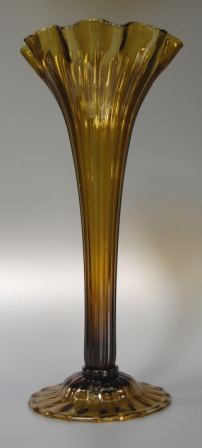
been mistaken as such. The ‘Trumpet Vases’ shown in this advert begin to allow us to understand Kempton’s
production.
However, far more is known about this period of Stuart’s production, which is fortunate,
since so much is still mistaken as the work of James Powell & Sons. In particular their green and straw opal pieces with
applied spiral trailing are often attributed to the London company. The
patterned, or embossed, straw opal pieces produced by John Walsh Walsh and Richardsons, such as the ‘Chestnut’
patterned series, are distinctive and can really only be attributed to these Midlands based companies, since Powell mainly
only produced pattern work on oil lamp shades. A number of these items were attributed to Powell back in the 1980’s
and 90’s in major auction house catalogues, understandably, since there was so little information available. Unfortunate
too, as it has led to an urban myth that is being perpetuated by unsuspecting dealers, collectors and indeed writers who have
used the auction catalogues as a source of information. Perhaps we can now begin to dispel the inaccuracy and give credit
to the companies where due.
Much of the work by companies other than Powell is heavier and as a result less fine in its
handling, but all have characteristics that are common to each other, sometimes making it difficult to determine the origin
of a piece. Things that are common are colour, dented, or pushed in sides and the styles of ribbed decoration used by most,
if not all the companies producing Arts & Crafts glass. These frequently used qualities begin to give a style that can
be readily recognised, but not so easily distinguished one from another, but nevertheless make it a challenging and interesting
area to collect.
 |
|
|
Examples of Arts & Crafts glass from various manufacturers
|
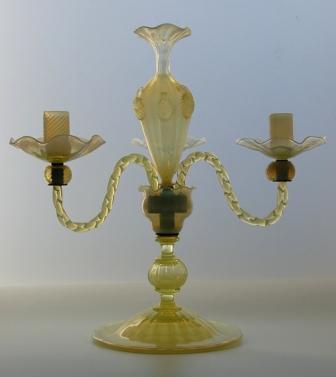
| A rare straw opal candlerabra by James Powell & Sons, c1890 |
|
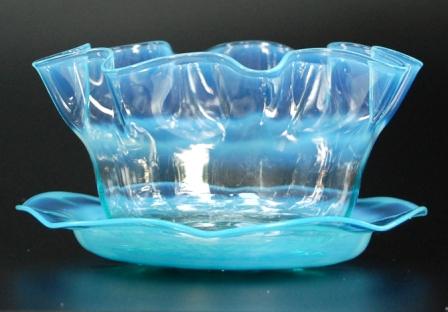
| Powell 'Blue Opal' finger bowl and ice plate c1880 |
|
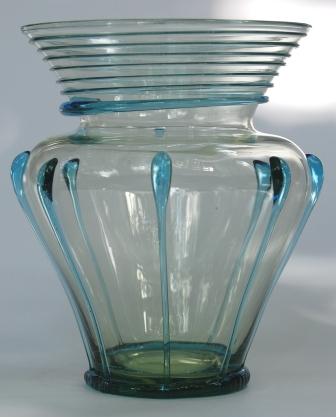
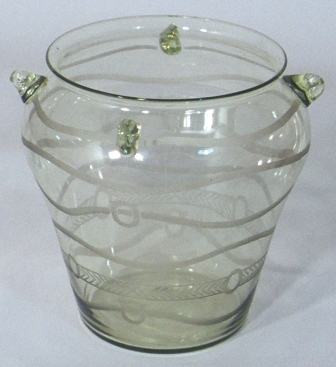
| Tear drop vase with spiral trailed rim by Harry Powell for James Powell & Sons, c1910 |
|
| Powell, a version of the 'King Minos' vase, designed by Harry Powell 1903 |

|
| James Powell & Sons drinking glasses , a group of TG Jackson designs from c1870 |
|
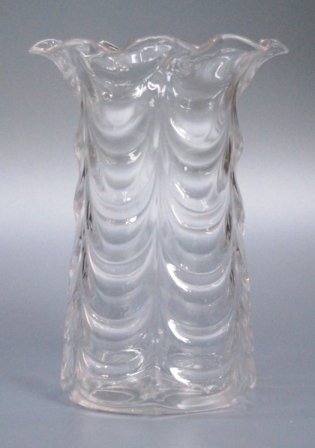
| Thomas Webb clear, wave ribbed vase c1920 |
|
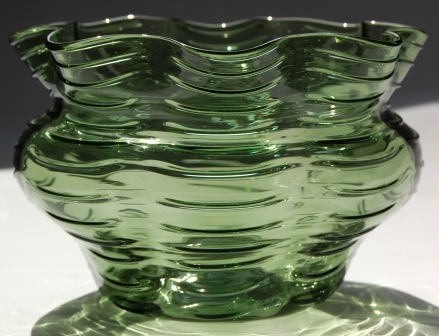
| Stuart wavy rimmed bowl with broken trail decoration, c1890 |
|
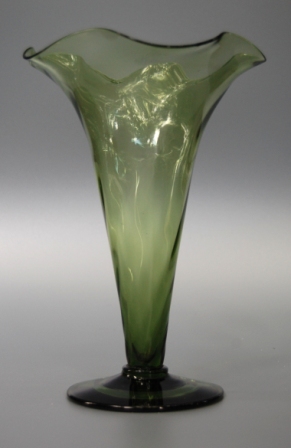
| Stuart & Sons wrythen, green vase with wavy rim c1920's |
|
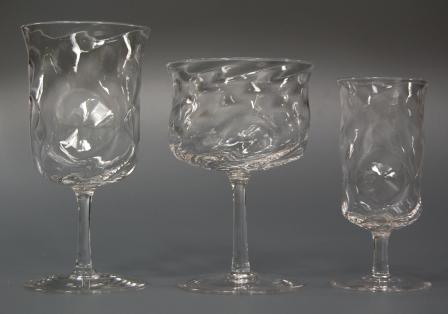
| John Walsh Walsh clear wrythen and dented drinking glasses, as shown in the 1927 catalogue |
|
| 'Trumpet' vase in old amber by Charles Kempton, shown in an advert from 1886 |
|
|
This is a burgeoning subject that is of particular interest to us, and as such we have interesting items from Stuart,
Richardsons, Walsh, Webb and Kempton; in addition we have a reputation of carrying extensive stock by Powell from 1865
to the First World War. If you are interested in purchasing any glass from the Arts and Crafts era, please
|